Fake crypto casinos on Discord, fake celebrity tweets, and PHaaS
A common pattern on Discord is not only “free Nitro” or fake captcha verification scams, but image spam that looks like a real X (Twitter) post from a celebrity. You receive a PNG or JPEG inside a DM or server channel: a dark-mode browser frame, a blue checkmark, follower counts in the millions, and a pinned announcement that a famous person has “launched” a crypto casino and is giving away thousands of dollars to everyone who registers. The post urges you to visit a short-lived domain, enter a promo code such as GIFT, and claims the bonus can be withdrawn instantly. It often adds artificial urgency (“this post will be deleted one hour after publication”) so you act before you think. None of that is a legitimate endorsement. The screenshot may be entirely fabricated, or it may impersonate a real account’s layout while pointing you to a criminal-controlled site. The casino itself is usually a copy-paste template sold to many operators, not a one-off hobby project.
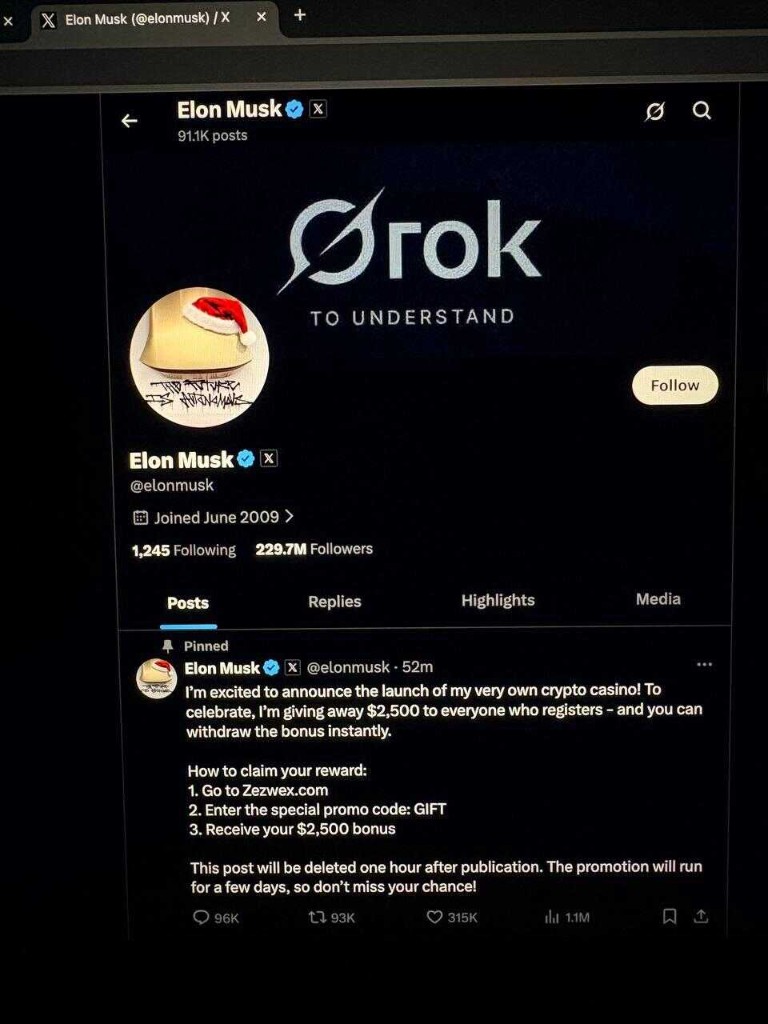
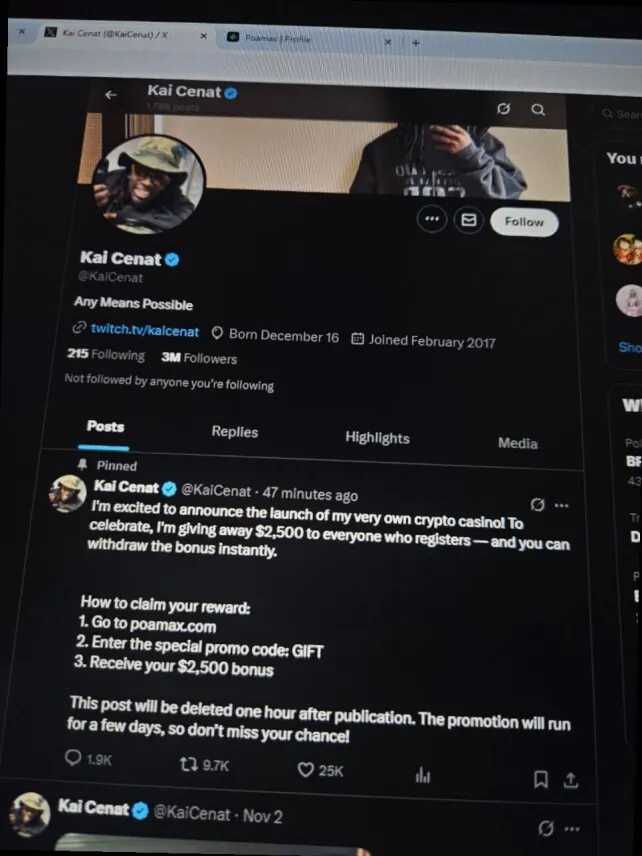
The same narrative repeats across different “celebrities” and domains. Another variant shows a high-profile streamer’s profile with the identical wording—same giveaway amount, same three steps, same urgency line—only the domain changes (for example poamax.com in one capture and poxmax.com in another). A separate capture attributed to the same celebrity template points to miolex.com with promo code HOT instead of GIFT, which matches how these programs work: the story is fixed while affiliate parameters rotate so operators can see which spammer drove the signup. Forgers sometimes add extra dressing—a bio link that does not match official properties, or a “reposted” row from an unrelated real account—to make the timeline feel busy and authentic at a glance.
That repetition across unrelated URLs is a fingerprint of a single campaign or kit, not independent casinos competing for your attention.
Because the lure is delivered as an image, automated link scanners in chat may never see the destination URL. Victims type the domain manually or follow a shortened link in a follow-up message. The next steps are always designed the same way: create an account, enter the promo code so the operator can attribute the signup to a specific spammer (many kits support /auth/register?promo=… links so the code is pre-filled before the victim even sees the form), watch a large fake balance appear in the dashboard, then discover that withdrawing it requires sending real cryptocurrency for invented reasons. Domains in the wild have included obvious typosquats and theme names such as ELONGAMB.COM alongside Zezwex.com, miolex.com, poamax.com, and poxmax.com—the point is rotation, not brand-building. Public investigations into MrBeast-style gambling scams have walked through live examples: verification deposits that climb from tens of dollars into the hundreds, “VIP XP” that only increases when you deposit more, fake AML or “high risk” holds, “security score” top-ups, tax or compliance fees, and even “untrusted IP” or wallet-connect charges. The English on pop-ups is often slightly wrong (“Your Withdrawal of $2500.00 Was Successfully”) while nothing actually settles on-chain. The goal is to extract as much as possible before the victim gives up. Any funds you send to these sites should be treated as unrecoverable.
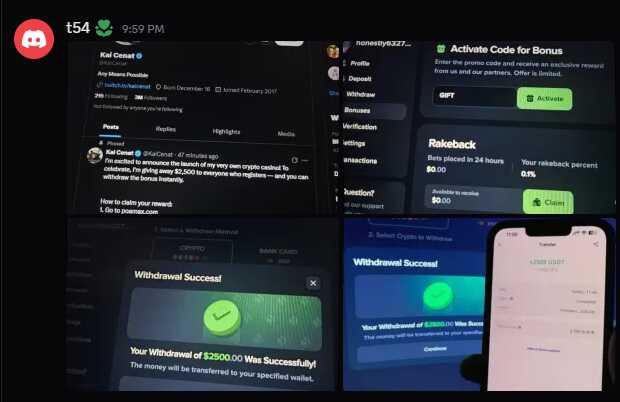
Scammers sometimes stitch together a four-panel “proof” collage in Discord: the fake tweet, the bonus activation screen with GIFT typed in, a green “Withdrawal Success” modal, and a phone held in front of the monitor showing a wallet app with a completed incoming transfer. That last step is theatre. On-chain you would verify addresses and confirmations yourself; a staged photo proves nothing. The composite exists to short-circuit skepticism right when someone searches for whether “anyone got paid.”
One template, many brands
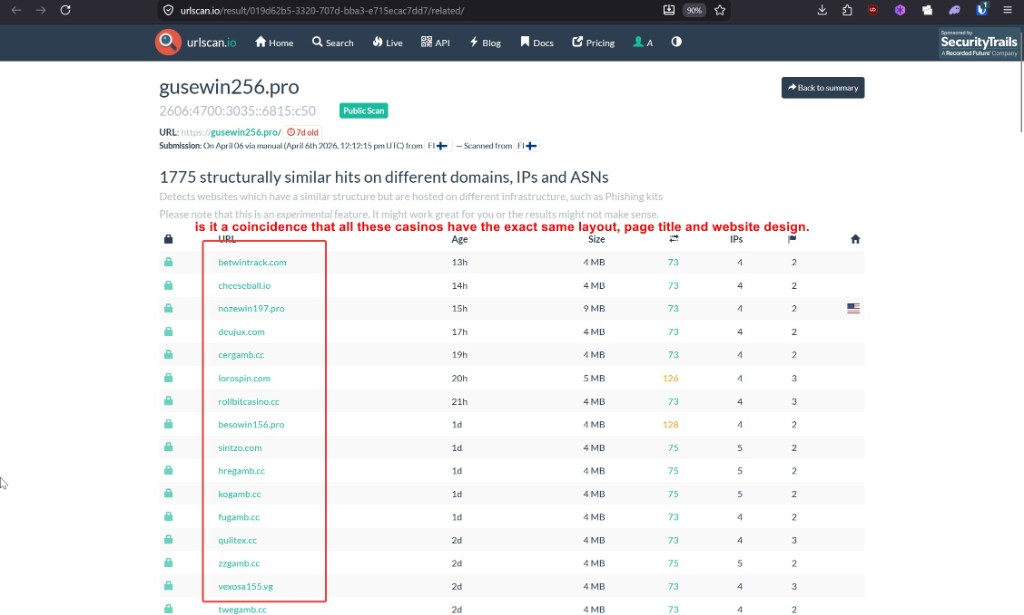
When researchers scan these domains, the same story appears again and again. urlscan.io and similar services cluster pages that share the same HTML structure, scripts, and assets. A single hostname might show hundreds or thousands of “structurally similar” results across other domains—same page title patterns, same navigation, same deposit flow. Independent submissions have shown on the order of 1,700–1,800 “similar” pages for different brand strings on different IPs and autonomous systems, sometimes with certificates issued for only a few months and domains only days or weeks old at scan time. Scans also routinely flag marketing and analytics beacons (for example Facebook and X/Twitter advertising-related scripts), which lines up with operator tooling that talks about pixel events and creative testing: the kit is not just a static page, it is a conversion instrument tuned like any other performance campaign. That is not evidence of a popular legitimate platform; it is evidence of one product deployed to many hostnames so blocking one URL does not stop the campaign. Localized skins exist too—German-language landings with the same title formula and the same game sections (“Original” / “Licensed slots”) have been observed under different vanity domains, matching the multi-language and per-country configuration options described in affiliate-facing documentation.
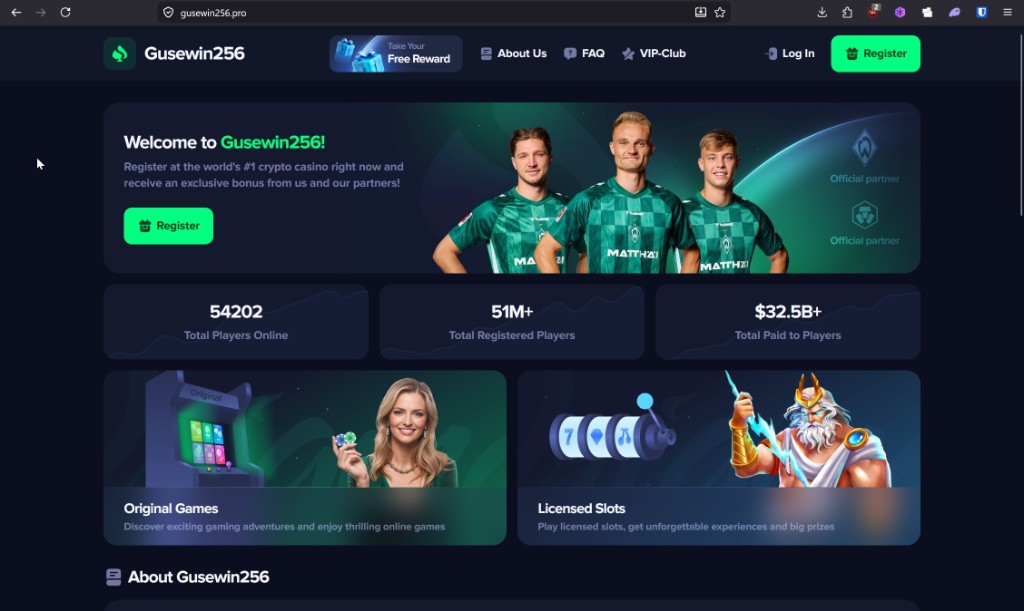
The live site is dressed to look like a serious crypto casino: dark theme, neon green accents, slots and “official partner” imagery, a sidebar for Profile / Deposit / Withdraw / Bonuses / Verification, and a persistent support widget. Front pages on clones such as gusewin256.pro have been observed claiming tens of thousands of players “online”, tens of millions of registrations, and billions of dollars “paid out”—figures that are not credible for a hostname that appeared days or weeks earlier, but they read as impressive at first scroll. Hero banners may borrow real sports photography and household crypto-brand marks to borrow legitimacy the operator never earned.
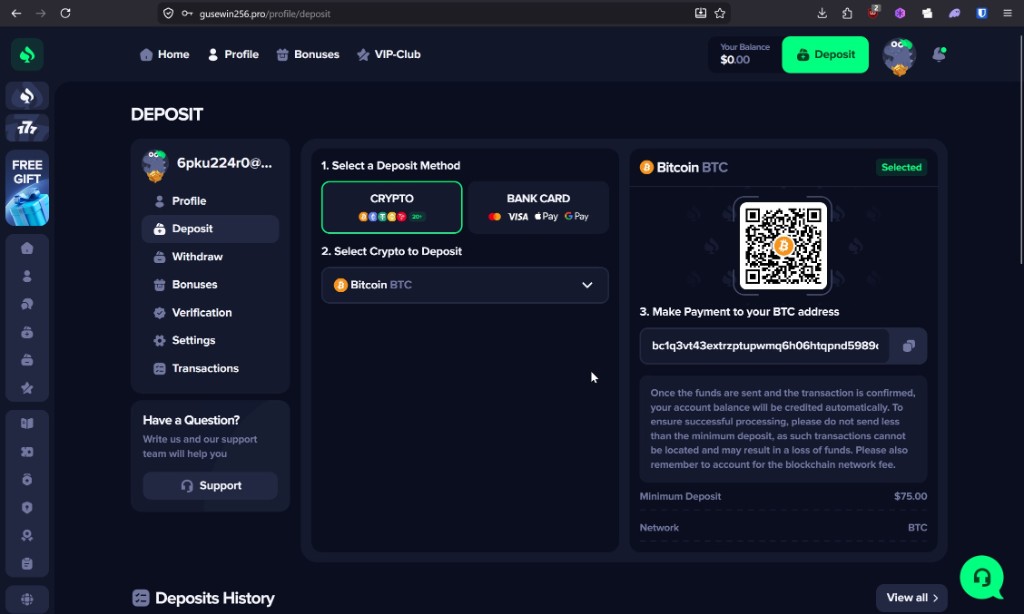
A concrete example from open-source captures is gusewin256.pro: a deposit screen at /profile/deposit walks the user through selecting crypto (e.g. Bitcoin), displays a QR code and a bc1… address, and states a high minimum (on the order of $75) with a warning that sending less may cause a “loss of funds.” High minimums and irreversible crypto rails maximize what each victim sends before they get suspicious. The same template often shows “bank card” as a secondary option in the UI while pushing users toward on-chain payment, because chargebacks are not available once coins leave the victim’s wallet.
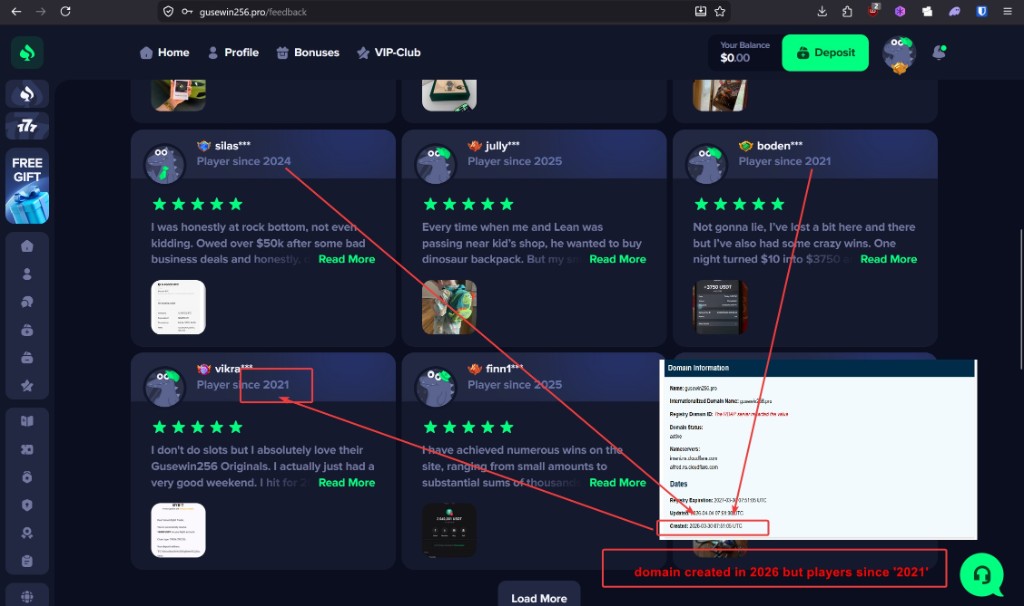
Template kits also ship fabricated review grids. On /feedback-style pages, cards show star ratings, sob-story testimonials, and badges like “Player since 2021.” When you compare those badges to public WHOIS creation dates for the same domain, the contradiction is stark: a domain first registered in March 2024 cannot honestly host players who claim to have been active since 2021. That mismatch is not a small copy error; it is what happens when social proof is generated from a static spreadsheet and nobody reconciles it with the registrar record for this week’s hostname.
Inside the logged-in experience, “Originals” lobbies (Crash, Dice, Mines, Plinko, and similar) sit next to promotion tiles that borrow recognizable faces from sports and entertainment without permission. Those rooms are not there to offer fair odds; in operator communities they are discussed as tunable house games that keep victims engaged while the real extraction happens through deposit-gated withdrawals and scripted support.
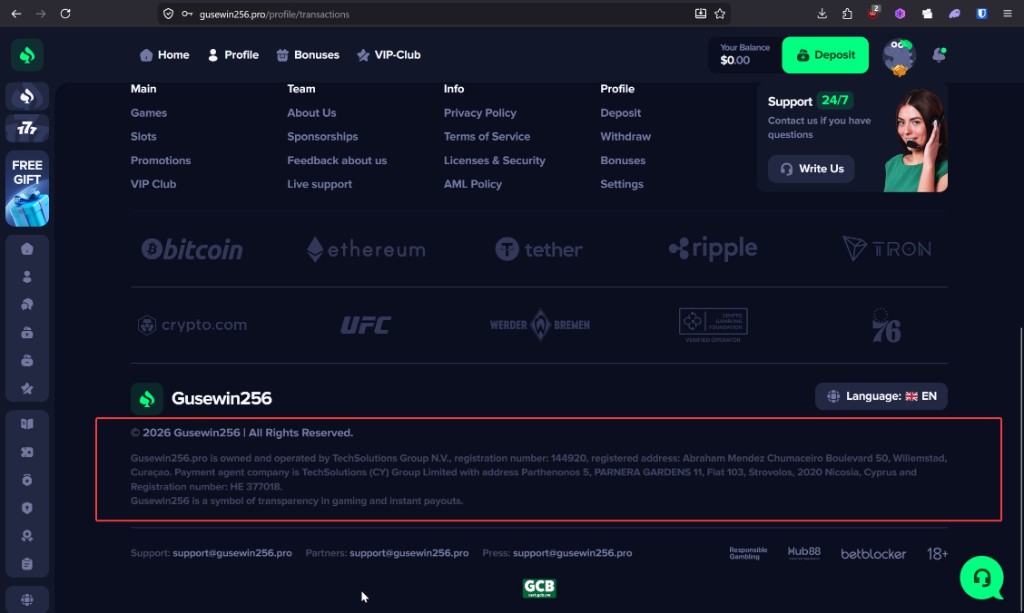
Footers on these clones pile on borrowed legitimacy: logos for major sports teams, payment brands, cryptocurrency tickers, and badges such as “Crypto Gambling Foundation” or “GCB.” Text may claim ownership by a named offshore company (for example language referencing TechSolutions Group N.V. and a Curaçao address) and a payment agent in Cyprus—details copy-pasted across many unrelated domains. In one capture, the copyright line even reads © 2026 while the domain itself is only days old, which is difficult to reconcile with a genuine long-running operator. Another tell is thin contact depth: distinct labels for “Support,” “Partners,” and “Press” that all resolve to the same mailbox on the scam domain.
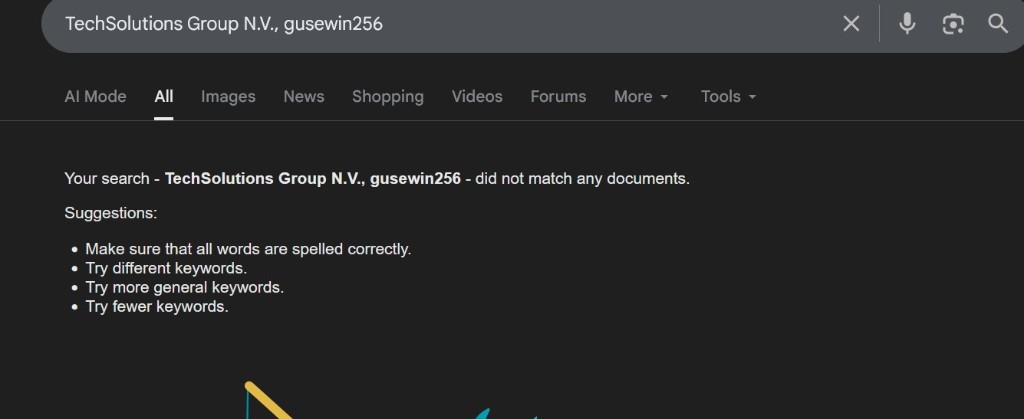
If you open several reported hostnames in the same browser, window titles can be identical (“Most Popular Online Crypto Casino Based on Blockchain” or similar), which is what you would expect from one codebase with different skins—not from independent businesses each writing their own positioning from scratch. The same pattern shows up in address-bar suggestions: a partial match for that title can surface a long list of unrelated hostnames on .pro, .cc, .cfd, .pw, and .vip, each prefixed with a different vanity brand but sharing the exact same trailing SEO string—including domains that typosquat well-known licensed casinos. Security researchers routinely pivot from that string into urlscan.io queries on page.title:"…" to enumerate new clones as they appear.
Operator tooling and how the ecosystem scales
Separate from any one Discord message, Telegram channels aimed at affiliates and panel customers have published long technical changelogs for products that match this world (often branded around “GAMBLER” and a gambler_panel bot). The posts read like enterprise SaaS release notes: promo URLs that pre-fill referral codes on registration (/auth/register?promo=… style paths), Terms of Service templates with variables such as %sum_verif% and %sum_afterverif% so the same legal boilerplate can pressure different deposit amounts per victim or tier, fake balance on signup, deposit modals tuned for conversion, switchable live-support personas (including scripted “chief admin” playbooks), one-click “send licence” material, per-country fake verification “error” amounts, optional AI live support trained on operator FAQs, guidance when Cloudflare suspends a domain, rotating panel and mirror domains, Facebook and Google pixel hooks for ad optimization, a materials page for ad creatives, “withdrawal reminder” nudges that pull users back into error states, tuning for rigged originals and even Crash prediction APIs—features that only make sense if the product is a fraud kit sold as a service, not a fair casino. Leaked or photographed operator dashboards reinforce the same point: one login can surface tabs such as “Website Management” with multiple active properties, which is exactly how you run a fleet of disposable brands from a single control plane rather than operating a single regulated venue.
That is phishing-as-a-service (PHaaS) in a gambling skin: customers rent the stack, point it at fresh domains (registrars and TLDs like .cc, .vip, .pro appear in operator chatter), and compete to push traffic while the core team ships mitigations and new social-engineering hooks. Reporting on adjacent campaigns has described Russian-language cybercrime communities, paid distribution through spam and phishing groups, and incentives for affiliates who rotate links as old domains burn.
Distribution is not limited to hacked Discord accounts pushing screenshots. Investigators have documented stealer logs and hijacked browser sessions (saved passwords and cookies) used to blast the same creatives from accounts that look “real” because they are real sessions stolen elsewhere. Malware distributed as game cheats or piracy tools has been described as waiting days after install before activating spam modules, which helps evade immediate suspicion. Bulk-purchased credentials, cross-platform spam on YouTube or TikTok, and comment-section seeding all feed the same funnel. Discord remains a high-visibility channel because large servers and compromised friends lists give the scam social proximity: the message arrives from someone you recognize.
What to do when you see this
Treat any unsolicited celebrity casino giveaway as malicious until an independent, primary source confirms it—and even then, legitimate operators do not onboard users through random .pro / .cc / .cfd domains slid into DMs with a promo code. Compare WHOIS registration dates to “established in” or copyright years in the footer; when the site is a week old but claims a decade of history, the story is false. Do not register for “research,” do not deposit to “unlock” a balance, and do not install remote-access tools for “support.” If a friend’s account sent the spam, assume compromise or coercion until they confirm otherwise and secure the account.
If you want adjacent context on how accounts get hijacked in the first place, read Discord fake verification phishing scam. Broader fake-support desk patterns are covered in Discord and Telegram support desk scam. For how malicious signing and wallet drainers differ from “send crypto to verify,” see Different Types of Cryptophishing.
If you already sent cryptocurrency, treat it as a financial crime: document transaction IDs, preserve screenshots and domains, and follow guidance from your local police or national cybercrime reporting line. Phish Takedown cannot reverse on-chain transfers to criminal-controlled addresses.
Still need help?
Open a support ticket